
The short answer
Sovereign AI is artificial intelligence that a business owns and runs on its own hardware, inside its own building or private network. Your data, your prompts and the AI's answers never pass through a public cloud service. There are no per query or per token bills. You own the machine, you control the model running on it, and you decide who can touch it.
Key takeaways
- Sovereign AI passes four tests: you own the hardware, nothing opens a door into your network, support works without seeing your data, and the cost is flat.
- If a vendor calls it private AI but cannot show you the machine in your building, you are still renting. Your data still travels to their servers.
- Open weight models from Meta, Mistral, Alibaba, Google and OpenAI run well on office hardware today. You are not locked to one AI company.
- Sovereign AI makes HIPAA, client privilege and data protection work easier. It does not make you compliant by itself.
- TechFides pricing is public: $5,000 setup and $500 a month for up to 5 people, $10,000 and $1,000 for a full team, $15,000 and up with $2,500 a month for multiple sites. You keep the hardware.
What is sovereign AI, in plain English?
Sovereign AI is AI you own instead of rent. It runs on a machine in your building, the data never leaves, and the bill does not grow every time someone uses it.
Most businesses use AI the way they use electricity from the grid. They pay by the month, by the seat or by the word, and every question they ask travels to a data center they will never see. That is fine for writing a birthday card. It is a problem for a patient chart, a client contract or a deal file.
Sovereign AI flips that arrangement. The AI model lives on hardware your business owns. Your staff reach it from their browser, their phone or the tools they already use. If you stop working with the company that set it up, the machine stays in your office and keeps running.
Where does the term sovereign AI come from?
The term started with countries. In 2024 NVIDIA's CEO Jensen Huang told the World Governments Summit that every nation should own its AI: its own computers, its own data and its own models. TechFides applies the same idea to a single business.

A country does not want its tax records, health data or national intelligence sitting in another country's data center. A medical practice, a law firm or a car dealer should not want that either. The logic is the same. Only the size changes.
We also bring this standard to governments. Municipalities and national ministries use the same approach to keep public records inside their own walls.
How is sovereign AI different from cloud private AI?
Cloud private AI still runs on a vendor's servers. Sovereign AI runs on yours. Everything else follows from that one difference: who sees the data, who sets the price, and who owns what is left after three years.
| Sovereign AI | Cloud private AI | |
|---|---|---|
| Where your data is processed | A machine you own, in your building | The vendor's servers, often shared with other customers |
| What leaves your network | Nothing, when it runs on premise | Every prompt, file and answer |
| How you pay | One time setup plus a flat monthly fee. No meters. | Per seat or per token, at prices the vendor sets |
| What you own | The hardware, the setup, your data and your copy of the model | Nothing. You rent access. |
| Model choice | Open weight models you can swap when a better one ships | The vendor's models, on the vendor's schedule |
| Compliance work | In your hands, with logs on your own machine | Tied to the vendor's terms and agreements |
| Works when the internet is down | Yes | No |
Watch the word private. Many cloud vendors sell private AI that still runs in their data center. Ask one question: where is the machine? If you cannot point to it, you are renting.
What are the four tests of true sovereign AI?
A system is sovereign only if it passes all four tests below. Miss one and you have something private, maybe, but not sovereign.
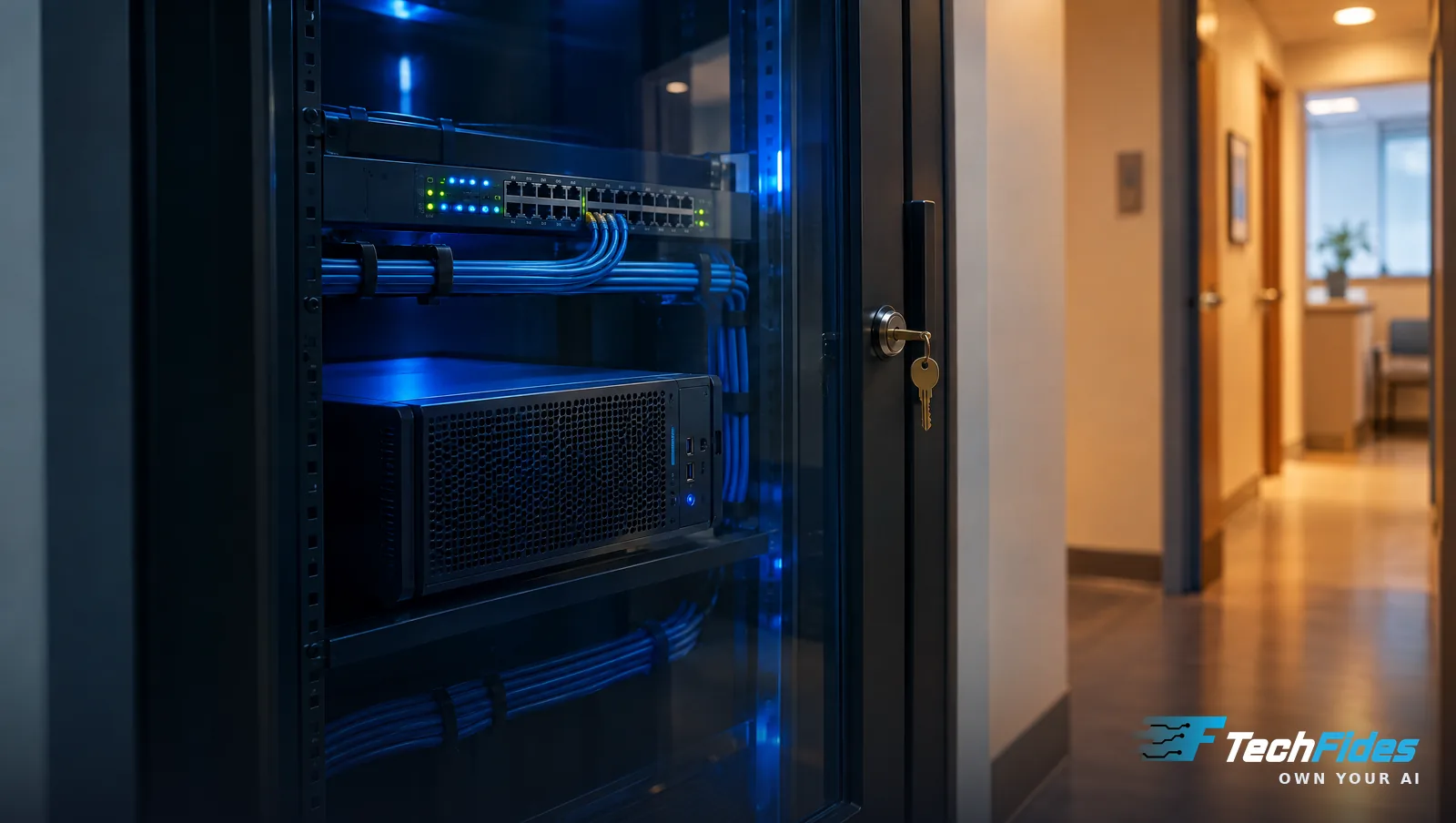
- 1You own the hardware. The AI runs on a machine on your premises and on your books. Leave the vendor and the machine stays with you.
- 2No door into your network. The system sits behind your firewall with no inbound port open to the internet. Nobody outside can log in to it, including us.
- 3Support without seeing your data. Health checks travel one way, out, and carry numbers only. Your files, prompts and records never go with them.
- 4Flat, predictable cost. No per query, per token or per user charges. Use it all day and the bill does not move.
How can anyone support a system they cannot reach?
Through a one way heartbeat. Every five minutes a small agent on your machine sends health numbers out to TechFides: uptime, disk, memory, load, temperature and whether each service answers. It opens no inbound port and never reads or sends files, prompts or records.

Every message the agent sends is written to a log on your own machine, so your team can read exactly what left the building. Nothing is hidden in an encrypted blob you have to trust.
When a number looks wrong, such as a disk filling up or a service that stops answering, it shows up on our dashboard and we reach out. Support requests are taken 24 hours a day. This is how a system can stay fully private and still be looked after.
What does sovereign AI cost?
A TechFides Sovereign system costs a one time setup of $5,000 to $15,000 and up, plus a flat monthly fee of $500 to $2,500. The setup includes the hardware, which you own. The monthly fee covers support, updates, model upgrades and the changes your team will ask for as they learn the system.

| Plan | Who it fits | One time setup | Flat monthly | 36 month total |
|---|---|---|---|---|
| Sovereign S | Solo and small offices, up to 5 people | $5,000 | $500 | $23,000 |
| Sovereign M | A full team at one site | $10,000 | $1,000 | $46,000 |
| Sovereign L | Multiple sites and larger teams | $15,000 and up | $2,500 | $105,000 and up |
Here is the honest part. If five people only need a chatbot, a public AI subscription is cheaper. Keep renting. Sovereign AI pays off when your data is sensitive, when usage bills keep climbing, or when the AI does real work like answering every call. Cancel with 30 days notice and the hardware stays with you.
Is sovereign AI compliant with HIPAA, SOC 2 and the FTC Safeguards Rule?
Sovereign AI makes compliance easier because sensitive data never goes to an outside AI vendor. It does not make you compliant by itself. These rules govern how your organization operates, not which machine you buy.
HIPAA still requires a risk analysis, access controls, audit logs and trained staff. The U.S. Department of Health and Human Services does not certify any product as HIPAA compliant, so be careful with any vendor who says otherwise. If a hybrid setup lets an outside AI service touch patient data, you need a business associate agreement with that service before go live. For medical practices we recommend on premise only.
SOC 2 is an audit of a company's controls, not a feature of a piece of hardware. If a vendor mentions it, ask for the report.
Auto dealers fall under the FTC Safeguards Rule, which requires a written information security program and oversight of every service provider that touches customer data. Keeping AI on your own hardware removes one more provider from that list.
For lawyers, ABA Formal Opinion 512 asks attorneys to protect client confidentiality when they use generative AI. A model that runs inside the firm's own network keeps privileged material away from third parties.
Which AI models run on sovereign AI?
Open weight models from Meta (Llama), Mistral, Alibaba (Qwen), Google (Gemma) and OpenAI all run on hardware a business can own. TechFides is model agnostic. We pick the model that fits the job and swap it when a better one ships.
This is part of ownership. Your machine is not tied to one AI company. When a stronger open model is released, we update your system as part of the monthly service. No new hardware, no new contract.
Who needs sovereign AI the most?
Any organization with a duty to protect what its clients tell it. The stakes are highest where one leaked file costs more than years of service.
- Law firms. Contract review and research with no privileged page leaving the network.
- Medical and dental practices. Visit notes and patient messages drafted with records kept on site.
- CPAs and financial advisors. Tax files and client statements processed without a third party in the middle.
- Auto dealers. Lead follow up and finance paperwork without adding another provider to your Safeguards program.
- Churches and nonprofits. Member and donor records that stay with the people who were trusted with them.
- Governments. Public records kept inside public walls.
When is sovereign AI the wrong choice?
Sovereign AI costs more up front, runs models that trail the very largest cloud models on the hardest tasks, and needs a partner to maintain it. You should hear that before you buy.
- Small, simple needs. If a few people only want a chat assistant for non sensitive work, a public subscription costs less.
- Frontier research. The very largest models only run in big data centers. For drafting, summaries, document review and phone handling, office hardware does the job well.
- No space at all. A machine needs a locked spot, power and a network cable. If that is impossible, our hosted option keeps your data private on a dedicated server, though it is not fully sovereign.
- Maintenance. Hardware fails and models need updating. The monthly fee covers this, but it is still a relationship with a service partner.
Are you renting your AI?
Eight questions, two minutes, no signup. See what you own, what you rent, and what renting costs you.
Straight answers
Frequently asked questions
Why are businesses moving from cloud AI to sovereign AI?
Three reasons come up in almost every conversation. The bills grow with every seat, every token and every new tool. Client and patient data travels to servers the business does not control. And after years of paying, the business owns nothing. Sovereign AI answers all three: a flat cost, data that stays in the building, and a machine that belongs to you.
Is sovereign AI the same as private AI?
Close, but not the same. Private AI is the broad term for AI that keeps your data away from public services, and some vendors use it for systems that still run in their own data center. Sovereign AI is the strict version: hardware you own, inside your building or private network, behind your firewall, at a flat cost. Every TechFides Sovereign plan is built to that standard. Our hosted and hybrid options are private, but they are not fully sovereign, and we say so up front.
What is the difference between using a public AI service and sovereign AI?
With a public service such as ChatGPT, Gemini or Copilot, your questions and files travel to the provider's servers and you pay per seat or per use. With sovereign AI, open weight models run on your own hardware. The questions, the files and the answers stay inside your network, and the bill does not change with use.
Can sovereign AI connect to our CRM and other business tools?
Yes. It talks to your databases, your CRM, your website forms and your office tools over your internal network. TechFides builds the CRM into the system, so there are no per user licenses to buy. One honest note: phone answering uses an outside voice service, which makes that one piece hybrid. We agree in writing what data it handles before go live.
Can TechFides see my data?
Not when your system runs on premise. It sits behind your firewall with no inbound port open, and TechFides has no remote way in. We support it through a one way heartbeat that reports machine health numbers every five minutes. It never reads or sends files, prompts or records, and every message it sends is logged on your machine.
Do I need a server room for sovereign AI?
No. Most offices of 5 to 25 people run on a single compact desktop machine that fits on a shelf. It needs power, a network cable and a door that locks. Larger teams move to a GPU workstation or a small server.
What does sovereign AI cost?
TechFides Sovereign S is $5,000 to set up and $500 a month for up to 5 people. Sovereign M is $10,000 and $1,000 a month for a full team at one site. Sovereign L starts at $15,000 and $2,500 a month for multiple sites. The setup includes hardware you own. There are no usage meters and no per user fees.
Sources
- 1.NVIDIA: NVIDIA CEO Says Every Country Needs Sovereign AI (World Governments Summit, February 2024)
- 2.U.S. Department of Health and Human Services: Summary of the HIPAA Security Rule
- 3.Federal Trade Commission: FTC Safeguards Rule, What Your Business Needs to Know
- 4.AICPA: SOC 2, SOC for Service Organizations: Trust Services Criteria
- 5.American Bar Association: Formal Opinion 512, Generative Artificial Intelligence Tools (July 2024)
- 6.OpenAI: open weight model release (August 2025)